Wednesday, October 10, 2007

New friends, Part I


My father experienced his 15 minutes of fame this past summer at a Wilco concert in Northampton, Mass. As Dad stood in the front row right along the stage, lead singer Jeff Tweedy knelt down by him, put his arm around Dad's shoulders, and performed a song that was part duet, part serenade. My sister reported that this was one of the more surreal experiences of her life, both for seeing her musical idol sharing this oddly tender moment with our 60 year old father, but also for the minor celebrity status it brought about for Dad and sis. The incident became a hot topic on Wilco message boards the following week, and several fellow fans approached them at that show and others upon recognizing them. A few of these even traded contact info with Becky and became pen pals.

Among these new friends was Elaine, a doctoral student in physiology at the University of Vermont. Upon learning about Dad and Becky's affinity for all things connected to the sea, not to mention their son/brother's professional connection to the marine realm, Elaine recounted a tale of her own ascent to celebrity status through a friendship with a giant lobster in a local supermarket. The gargantuan crustacean, appropriately nicknamed Andre, had made his way from the briny Atlantic to the Price Chopper in Burlington. There, Elaine and her friend Crystal developed a fondness and admiration for the big fella, and began an effort to raise money to buy him and save him from the dinner table. Their cause sparked a local stir, and they soon had an offer from a local pilot to fly the pair with their new friend down to Boston so he could move into a new home at the New England Aquarium, where he will serve a valuable educational role. Watch a video clip of the trio's odyssey from WPTZ TV here.

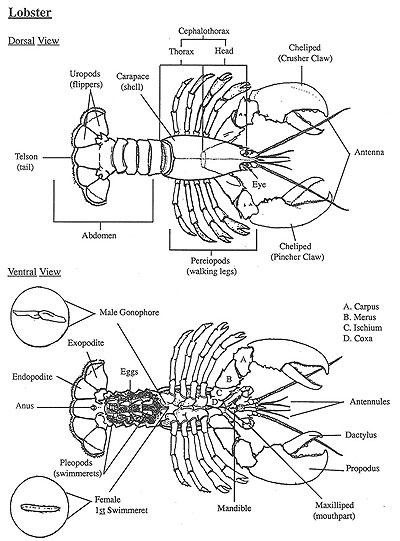
The news report does not comment on Andre's age or length. The relationship between size and age in lobsters is highly variable, as in many marine invertebrates, and depends upon temperature, food and habitat quality, and inherent genetic traits, among other factors. The relationship between length and weight, on the other hand, is typically very consistent. Using a published equation for lobsters in the Gulf of St Lawrence, at 17 pounds Andre is probably just over 200 mm in carapace length (CL; i.e., the main body of the animal covered by the largest section of shell, as illustrated here), which is around 8 inches. Since the carapace is only about half the total length of the animal, Andre probably measures at least 16 inches from head to tail, not including the claws. In the Bay of Fundy, lobsters take 20-35 years to reach 200 mm CL (as measured in this study), which gives us a ballpark estimate of Andre's age.

To put Andre's size and age characteristics in perspective, The Lobster Conservancy (whose website is well worth browsing for a wealth of information on lobster biology and fisheries) reports that about half of the lobsters in the Gulf of Maine reach maturity just before they reach the size at which they can be legally harvested. In Long Island Sound, very few lobsters remain in the water after they reach the minimum legal size (see Figures 5 and 6 in this CT DEP report), and the recent stock assessment by the Atlantic States Marine Fisheries Commission (the interstate body charged with setting coast-wide lobster harvest regulations) shows similar patterns in other locations (find it at http://www.asmfc.org/ and see Figures 3.1.1 and 3.1.2). Therefore, fishing pressure is quite intense and most lobsters probably do not get a chance to spawn more than once (yet, lobster populations remain remarkably resilient to this pressure).

The Lobster Conservancy also shows how a marginal increase in the minimum size in the 1980s seemed to spawn (pun fully intended) a rapid increase in the lobster stock due to the greater average fecundity of the spawners who were afforded more time to grow and spawn. So, monsters like Andre (and I say that with great affection as a long-time fan of Godzilla, who is seen battling a giant lobster above in "Godzilla versus the Sea Monster") have not only pulled off an impressive feat in avoiding the traps for so many years, but they probably play a disproportionately important role in producing the next generation of lobsters (especially true of Andre's girlfriends).

So hats off to Elaine for getting the big guy to a place where he can help teach others about these remarkable bugs of the deep!

Tuesday, September 4, 2007

Postscripts


August saw a fair bit of vacation crammed into a single month for your favorite blogger, with one result being a post-less month. The month began with a canoe camping expedition in Algonquin Provincial Park with two Aussie diplomats and Brooklyn poet (not to mention the lovely lady pictured above and several of her friends, along with mink, bullfrogs, loons, mergansers, and other critters). Follow-up expeditions in New England – a 100 mile running relay down route 100 in Vermont and a climb to the Lakes of the Clouds hut on Mt Washington, complete with a mountaintop wedding – kept the action and adventure going. But, in the words of the great minstrel Marshall Mathers, it’s time to snap back to reality.

Part of that snap means once again meeting my obligations to the Running On faithful (I know the six of you have been waiting with bated breath), and several posts will be forthcoming in the fall. Before getting to those, however, I need to address a few things in my last few posts.

Firstly, re-reading “The root of all evil?” I feel a little funny for picking on an Islamic creationist while letting all of the fundamentalist Christian nutjobs off the hook. To be sure, Mr. Yahya deserves the criticism I directed toward him for taking the extraordinary step of trying to forcefully inject his pseudo-science into the academic world, a step I have yet to see be taken by a Christian creationist or “intelligent design” proponent (Dr. Michael Behe notwithstanding). However, in decrying creationism, I should have thrown in a jab at the Bible thumpers in the interest of balance (although I will most definitely go here if I’m ever in the ‘hood). Also in the interest of balance, have a look at this excellent essay on the profound contributions of Islamic scholars in days gone by to the global body of scientific knowledge, a tradition that has sadly been greatly diminished (but not lost).

Onto “Symbiotic Betrayal”: Sigh. On the plus side, my hunch on the “scumbag or not a scumbag” question concerning Michael Vick has proven to be correct (of course, when the feds hand down a 19-page indictment, they've usually got their man).

On the down side, I grossly overstated the nature of our relationship with our canine friends. If I had stopped to give it a half-second’s thought, I would have quickly realized that what we now have is in fact domestication and not symbiosis. The relationship started as a symbiosis, when wild dogs would scavenge at the fringe of hunter-gatherer camps, and in return for the free feed would probably warn the people in those camps about lurking sabretooth tigers or whatever nasties might be nearby. However, once we took them in and began controlling their breeding, learning, feeding, etc., the relationship became something very different from a true biological symbiosis. I think I was a bit fired up about Vick and wanted to make a statement, so I needed to cram it into the context of the blog. I also think I wanted to include a picture of the mighty Caz, as well as the long and varied list of services provided by dogs. And it is because of those latter two elements that I am leaving the post up rather than hide my scientific shame. It took a LONG time to find all of those dog links!

Some final comments on Vick and dogfighting: Some have argued, including one RO loyalist, that the Vick situation is a witch hunt, is far less important than other issues, and has parallels with other sensationalist news stories, such as OJ, Michael Jackson, Anna Nicole, Britney, Lindsey, etc. I agree to a point. There are more pressing issues, but that doesn’t make this OK and shouldn’t let him off the hook. It is not comparable to the other celeb tales listed because those are the isolated cases of a few wackos who live in a world so far removed from that most of us know as to make them mere freak shows, distractions and nothing more. That’s not to say that murder, pedophilia, drug abuse, etc., are not real problems, but we will learn very little about those issues by obsessing on these extreme outlier situations (how many cases of pedophilia – alleged or otherwise – begin with a former child star who grows up to have his own theme park and bizarre skull collection???).

Vick’s case, on the other hand, is symptomatic of a larger problem. He was immersed in this culture, one not unique to sports stars. And therein will lie the true test of our outrage. If we are on more than just a witch hunt, then we will demand that this deplorable practice be stamped out across the country now that this high-profile case has called it to our attention. PETA and the Humane Society will offer Vick a chance at redemption after he serves his time by serving as an anti-dogfighting spokesman, donating a portion of his future salary to the cause (he will play again; pro sports have no shame – just ask Latrell Sprewell), and so on, and we will put our money where our mouths are in supporting them. However, once Vick is sentenced and in jail, if we then simply turn to watch what Joey is able to do with the Falcons (well, or something less gruesome), then our righteous indignation will prove to be little more than a big pile of dogshi…

Monday, July 23, 2007

Symbiotic Betrayal


By now, all sports fans and animal lovers, and most people who glance at a newspaper from time to time, know that Atlanta Falcons quarterback Michael Vick and three others have been indicted by a federal grand jury on multiple crimes related to a dogfighting operation. That Vick is a remarkable athlete is without question. Whether he is also a deplorable scumbag remains to be seen (my official innocent-until-proven-guilty stance is that the jury is still out; my gut feeling after reading the 19 page indictment is an unqualified "yes").

Regardless, why do I raise the Vick indictment in a blog that has variously covered ecology and natural history, environmentalism broadly and marine conservation specifically, and the intersection between science and public policy? It is because the issue pertains to the relationship between humans and dogs that represents a type of mutually beneficial symbiosis. In fact, in my mind it is the most diverse and unusual symbiosis in all of nature.
"Symbiosis" is a broad biological concept representing any close, long-term interaction between two species. Not all types are to the benefit of both species, specifically the many types of parasitism (e.g., mistletoe that stunts the growth or kills host trees; isopod crustaceans that adhere to the tissues of marine fish). However, in my mind the more intriguing types benefit both species involved, a sort of evolutionary partnership. Marine examples of these mutualistic symbioses abound. Corals are able to form magnificent reefs by housing photosynthetic algae called zooxanthellae, which act as a sort of internal power station. There is an unwritten law somewhere that every dive magazine ever published must contain at minimum three photos (including ads) of a clownfish or anemonefish and its partner anemone. And the terrestrial world is not without its examples, too. The hippopotamus has a somewhat complex symbiosis with the oxpecker, which removes ticks but might also prolong wounds, and a more straightforward (and more funky) one with the black labeo fish, which cleans the inside of the mouth when the hippo is submerged. This is but a sampling of the many and varied ecological partnerships we called symbioses.

But our own symbiosis with dogs particularly fascinates me. Perhaps I am biased as a member of one of the species partners. Still, in exchange for providing shelter, food and other care, dogs have come to provide a wide range of services to people. This diversity has come to rely upon considerable coaching and selective breeding from our end, to be sure. But the origins of the partnership probably lay in a decision on the canid end to come to us. From there it grew, and has now evolved to span a wide array of services:

Nowhere will you find a symbiosis so wide-ranging. And those who practice the sick, grotesque, and - thank you Sen. Byrd - barbaric "sport" of dogfighting have betrayed a longstanding and productive relationship. If we do not stamp this out across the board (not just as it involves one high-profile athlete) we will perpetrate a gross dishonor to evolution, our historical heritage and, most importantly, our friends.


Thursday, July 19, 2007

The root of all evil?

That "money is the root of all evil" is one of our most misquoted sayings, and I am often quick to remind people that the original line from the New Testament (Timothy 6:10) is actually "For the love of money is the root of all evil." The complete quote more accurately places blame for ills done in the name of the almighty dollar on the ill-doer who covets that dollar, rather than on the dollar itself. Indeed, a slip of paper or chip of metal has little potential to do harm on its own and requires a living, breathing person to put it to negative use. Moreover, money can do enormous good in the right hands, as Bill Gates, Warren Buffett and Richard Branson all demonstrate.

There is, however, something to be said for the misquote given the many instances of people committing nefarious deeds not out of a love of money, but rather using money to achieve power, advance a counterproductive agenda, or otherwise act against the public good. As a recent example, Islamic author Harun Yahya (a.k.a. Adnan Oktar) has produced a new book entitled Atlas of Creation and has distributed a large but unknown number of free copies to institutions across the U.S. and elsewhere. Production and widespread distribution of the book could not have taken place without considerable financial resources, and the giveaways suggest that profit (i.e., "love of money") is not the motive. Instead, the motive is to effect a shift in public opinion. Money made the effort possible.

Now, I am not implying that Mr. Yahya has a sinister motive in producing and distributing the book. However, the simple fact of the matter is that he is dead wrong. That in and of itself is not a problem, except that by perpetrating the argument that biological evolution is a fallacy, he is contributing to the regressive trend in science education that sadly is too common across the U.S., and to a lesser extent other nations. Furthermore, evolution is not merely a theory to be studied and refined within the ivory tower as a primarily esoteric and academic exercise. Rather, as the unifying concept in all of the life sciences, understanding evolution is critical in advancing fields from the micro-level like epidemiology to the macro-level like ecology and conservation biology, fields with enormous and important practical applications.

As a staunch believer in the First Amendment (regardless of whether it is enacted in the U.S. or elsewhere), I would never advocate restricting the right of Mr. Yahya or anyone else to express his or her views. Of course, money allows some, like Mr. Yahya, to do more with their free speech than others. The internet has offset this imbalance to a degree, as discussed by Vice President Gore in his new book The Assault on Reason (and evidenced by yours truly and others who have caught the blog-bug), but the fact remains that with less cash in the bank we will never reach an audience the size of those who can pay for greater advertising and distribution. This is an imbalance we can and must live with.

My biggest problem, however, with the approach taken by Mr. Yahya is that he is addressing a scientific issue but skirting the scientific process. Science necessarily restricts free speech to a degree by requiring that any analysis or interpretation to be published, and therefore made part of the permanent scientific record, meets a high level of scrutiny. As scientists, our collective assumption is that what appears in the literature represents a rigorous analysis of data collected with a sound experimental design and interpreted as objectively as possible, free from bias and prejudice. This does not mean that everything published is definitively "true". "Truth" is a tricky concept in science. From microbiologists to astrophysicists, we are trying to understand complex, interacting systems that are often not able to be directly perceived with our five senses. We rely on indirect impressions of a piece of the system of interest, quantified, analyzed and interpreted as best we can. Because the data often provide an imperfect picture, subjectivity inevitably creeps in, and differing perspectives arise. But we all trust that those perspectives have been adequately critiqued to ensure that, though we all might not agree, the conclusions have been reached in a scientifically valid manner.

Mr. Yahya has avoided the scrutiny of peer review and the scientific process, but is trying to inject his work into the scientific community nonetheless. That, to me, is a huge problem. He knows, undoubtedly, that his interpretations would not hold up, so going through the process was probably never a consideration. They would not hold up because his perspective is rooted not in science but rather in religion, albeit dressed up to look like science. And religion, while capable of promoting solid morals and doing tremendous good, is also capable of tremendous harm. The prominent evolutionary biologist Richard Dawkins has gone so far as to suggest that it is religion that is actually "the root of all evil". The actions of Mr. Yahya and others that work against reason and scientific progress (and all of the benefits it brings) suggest that he might be right.

Monday, July 2, 2007

Simplistic and shortsighted

My friend Hal sent me a recent opinion piece from the Wall Street Journal that is critical of the modern environmental movement, yet is so full of holes that we should be calling for Dear Liza. A few quick (by my verbose standards) responses to claims in the article:

1. Perhaps the most mind-bogglingly naive statement in the piece is the following: "If cost-effective technologies to boost energy efficiency actually existed, industry would adopt them automatically, global warming or not." While I am attracted to many elements of libertarian philosophy (Dalmia works for the libertarian Reason Foundation), this gives far too much credit to the rationality of the free market. If the statement were true, the EPA would not have needed to cite and fine Wal-Mart for violation of idling regulations, a practice that needlessly burns 2.1 million gallons of diesel fuel each year (note: that fuel costs them money), despite a fairly simple cost-saving and environmentally beneficial solution (turn off the freaking engines!). As a fisheries biologist, the number of examples I have seen of fishermen irrationally outstripping the reproductive capacity of the resources that support their livelihood also challenges the assumption that industry will find the most sensible solutions.

2. The argument against energy efficiency ignores the tremendous savings that can be achieved by improvements in private homes, in addition to those by industry. If our government provided better information on how to make homes more energy efficient, as well as grants, loans and tax breaks to help bring about needed improvements, we could drastically reduce the need for hydropower.

3. On alternative energy sources, the piece states that most "...are still far from economically viable." This is true, but it ignores a huge factor. Dalmia notes that huge subsidies were originally provided to make many hydro dams possible. She fails to mention the subsidies still provided to make fossil fuel use "viable" (but likely adopts the alternative view). If solar, wind, wave and tidal (a.k.a. hydrokinetic), and other sources were given the same government support, these might be more economically viable sources in the near future, if not already. It's become somewhat cliche, but it's still true nonetheless, that if we had the same sort of "man on the moon by the end of the decade" vision and leadership today on renewable energy that JFK provided in 1961 on space exploration, we'd be having a very different debate right now.

4. There are a series of examples of green groups opposing alternative energy developments. The implication seems to be that if environmentalists claim that climate change is our most serious threat and therefore we do not unquestioningly accept all such renewable proposals, then we are obstructionists and hypocrites. This is a dangerously simplistic view. We need energy, and ALL energy sources have environmental impacts. That cannot be avoided. But asking questions about where to best locate facilities to minimize impacts is not only legitimate, it is irresponsible to not ask those questions. Although some will oppose all wind power, for example, if it has any impacts on birds whatsoever, many will want to ask the reasonable question of where to place a wind farm to achieve the optimal balance between ecosystem health and energy production. Indeed, one of the more radical environmental groups provides one of the more thoughtful analyses of a highly controversial wind farm proposal (the controversy stemming less from genuine environmental arguments and more from concerns over aesthetics and property values). The debate does not have to be between low-carbon energy and birds (or salmon - "damn" them?). With sound planning and ingenuity, we can have both.

5. The jab at Vice President Gore is a cheap shot. The progress toward mitigating climate change that Gore is helping to bring about is unprecedented in the history of environmentalism. We'd probably need to go back to Teddy to find a leader of such stature who has put environmental issues at the forefront of public policy. When Gore helps Congress pass a carbon cap-and-trade bill (which will let the free market do most of the legwork toward sorting out the problem), he will have done more than offset whatever greenhouse gases his mansion and cross-country flights are producing.

Thursday, June 21, 2007

Losing fish, losing cultures


My last post raised the issue of a resumed whale hunt by the Makah tribe, noting that it is deeply connected with who the Makah are as a people. Yesterday, I discovered an article in Canada’s Globe and Mail (delivered to the door of my hotel room here in the beautiful city of Halifax) about drastically declining spawning runs of the eulachon. This is a small species of smelt that could almost be seen as a west coast version of river herring (see the post that launched this blog for more on those fish). The eulachon runs have long formed the basis of the Nuxalk tribe’s way of life, and their demise could mean the end of their culture, or at least a radical transformation. I don’t know much about eulachon (my east coast bias shining through), but I suspect they are important prey fish for many predators, so the collapse of their stock may be having ecological ripples beyond the cultural effects on the Nuxalk.

Lost traditions due to depleted fish stocks is not a phenomenon that is unique to indigenous cultures. Commercial fisheries for river herring are among the oldest in North America. North Carolina in particular has the largest in-river fishery, one that is not just a source of income but is also a way of life for the fishermen and part of the state’s coastal heritage. That fishery is now being closed in response to the severe declines in abundance. Like the eulachon, which might be declining due to shrimp trawlers, the problem might lie offshore in the form of river herring bycatch in open ocean fisheries for Atlantic herring and Atlantic mackerel. Despite the name, river herring actually spend the majority of their lives at sea, and could be vulnerable to multiple impacts away from rivers and the coast.

Although there are many bad signs for many species of fish, I can happily report that this past spring we documented for the first time in many years a spawning run of alewife in the Swan River on Long Island. Those fish are pictured above.

Tuesday, June 12, 2007

Whale tales


My last post two weeks ago focused on the world’s largest land animal. Shortly after those musings on elephants, my attention turned to the world's largest animal on land or sea when I read that Japan is once again threatening to leave the International Whaling Commission (IWC). Japan does this from time to time, whenever the IWC votes for regulations it does not like. Each time, their threats turn out to be empty.

Hunting whales, like hunting seals, is seen by many people as a relic practice of an earlier age that is neither necessary today nor consistent with ‘modern’ values. For the most part, I am inclined to agree. Values are not static. They change and evolve, and what was acceptable in the past might not be acceptable now. Whaling was vital to the growth of Nantucket and New Bedford, and provided useful resources for a growing nation. But those resources were replaced by alternatives that were more abundant and accessible, and with that shift (not to mention the depletion of whale populations), the whaling industry faded away. It is noteworthy that our relatively newfound appreciation for whales and associated moral opposition to killing them came after they had declined in value. Despite the cause of this revelation, I personally feel that whales have a level of intelligence, social complexity, and overall uniqueness that warrants special status in the animal kingdom (my close encounter with a fin whale off Nantucket pictured above still gives me goose bumps).

However, I am hesitant to impose this ‘enlightened’ view on all cultures. The whaling industry had a relatively brief duration in the history of European settlers in America. But whaling has been an integral part of other cultures for much longer. The Makah tribe of Washington state have a long history as a whaling people. After a nearly 150 year lay-off from whaling (a fairly short period of time in the context of the history of the Makah), the tribe resumed the hunt in 1999 amidst substantial opposition and controversy (for more on Makah whaling historically and today, check here). I support their right to hunt to help maintain their independence, identity and tradition.

I have similar sympathies for nations like Iceland and Norway that argue for the right to hunt whales on the basis of longstanding traditions. There are indigenous whaling cultures in Japan, but the nation hurts its arguments to continue whaling for cultural reasons by its continued claim of the need to continue large-scale whaling operations for scientific reasons. This is a very, very, very thinly veiled commercial hunt of 1,000 or more whales annually. A bowhead whale caught off Alaska recently had the remnants of old whaling gear lodged in its neck that placed its age at between 115 and 130 years. This mind-boggling longevity is exactly why anything more than a limited hunt for cultural reasons is unsustainable. A species living a century or more cannot support industrial harvest at the level Japan would like to hunt.